


Apple cider vinegar is available in every household.It is used to prepare various dishes and whiten things, but few people know that with the help of apple cider vinegar you can also get rid of some diseases - for example, nail fungus.At the same time, if safety precautions are observed, it is almost impossible to harm the body, since vinegar is based on ordinary apple juice.
Effects of apple cider vinegar on fungi
The fungus is afraid of an acidic environment, so apple cider vinegar not only kills these microorganisms, but also prevents them from multiplying.This is an excellent antiseptic that can quickly relieve symptoms of onychomycosis such as itching, irritation and inflammation.In addition, the fruit acids contained in this product have a positive effect on the structure of the nails.
So, apple cider vinegar:
- works against nail fungus on hands and feet;
- kills germs, bacteria and other harmful microorganisms;
- strengthens the nail plate
- relieves unpleasant symptoms of mycosis
- fights inflammation
However, apple cider vinegar alone won't help if you don't pay attention to hygiene:
- Wash your feet and hands regularly;
- Change socks and clothes in a timely manner;
- Shower at least once a day;
- Do not use other people's hygiene products;
- Avoid weakening the immune system due to vitamin deficiency.
- Do not go barefoot in the bathhouse, sauna or swimming pool.
Additionally, this home remedy may not help in all cases.
When should you use apple cider vinegar?
Apple cider vinegar does not always help treat nail fungus.In some cases it provides little or no benefit.We are talking about advanced stages of the disease.If more than a fifth of your nail is damaged, vinegar can only be used as an aid.But a doctor needs to deal with such a fungus.Don't be shy or afraid of dermatologists - no one will think you are sick because you don't pay attention to your hygiene.Anyone can get a fungus - it is a very contagious disease.But it is the doctor who has to prescribe medication that really helps.
Another case where vinegar should not be used is open wounds.With fungi, the situation where part of the nail peels off and falls off into pieces is not uncommon.The result can be painful wounds.Of course, if acid gets into them, there will be not only increased inflammation, but also severe pain as a result of a chemical burn.
Methods of use
Vinegar can be used to treat nail fungus in a variety of ways.Depending on your preferences and ease of preparation, choose an acceptable option.
bathroom
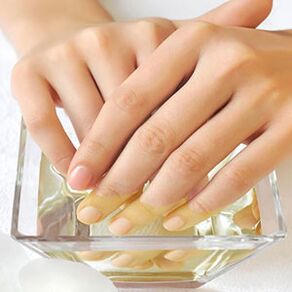
Vinegar baths are a great option for anyone who has 30 minutes of free time.After that, not only will your nails become healthier, but your skin will also become softer, your feet will no longer sweat profusely, and the unpleasant odor and itching will disappear.
The simplest bath with vinegar goes like this: Pour 150 ml of 5% apple cider vinegar into 5 liters of hot water.Leave your nails in this solution for about 20 minutes.Wipe the affected nails dry, cut them at the root, and put on clean socks or gloves.
Baths with vinegar and other ingredients have also proven to be excellent:
- Bath with vinegar and essential oils.They not only help remarkably against nail fungus, but also against other dermatological problems.When adding essential oils, please note that they are not suitable for everyone as they are quite an allergenic product.If you experience itching, red spots, or a rash, wash your skin immediately with clean water and apply allergy cream.Add no more than 3-4 drops to the bath - this is enough for a therapeutic effect.
- Baths with vinegar and soda.Add 1 tablespoon of baking soda and 50 ml of vinegar to 1 liter of water.While the reaction is taking place, leave your nails in the bath for 25 minutes.Dry thoroughly and do not wash for at least 3 hours.
- Bath with vinegar and celandine.To prepare this bath, you need to purchase a collection of celandine at the pharmacy and pour 1 spoonful of the herb into a glass of boiling water.Let it steep and add 4 liters of hot water.Add 100-150 ml of natural apple cider vinegar.Do these baths every day for 30 minutes for 2 weeks, and the result will not be long in coming.
- Baths with vinegar and hydrogen peroxide.For every 1 liter of water, add 2 tablespoons of vinegar and 1 tablespoon of peroxide to hot water.Leave your nails on for 20-30 minutes.Wipe it dry and apply an antifungal cream.
lotions
The lotion is a moist compress that is applied briefly.For the vinegar lotion, you will need a medical cotton swab or a regular cosmetic cotton pad.Dip it in vinegar and apply to the nail plate damaged by the fungus.Keep this going for as long as possible – at least 1-2 hours until the vinegar evaporates.This option is good because you can get faster results thanks to pure vinegar.For a better effect, you can add onion juice, peroxide or a little soda.
Apply vinegar to nails
The lubricant can be used to quickly stop the development of nail fungus, but the effect of this treatment cannot be expected quickly.The purpose of lubrication is to briefly apply vinegar to the damaged nail.Unfortunately, the effect of such treatment will be noticeable if you carry out the procedure at least 10 times a day for 2-3 weeks.
However, you should not immediately refuse this method of using vinegar.If you lubricate healthy nails, you prevent the development of the disease.
Apple cider vinegar recipes for nail fungus
There are several dozen recipes for nail fungus in folk medicine, many of which contain natural apple cider vinegar.Let's look at the most famous recipes.
Compress made from vinegar and baking soda
Take a small piece of gauze or a handkerchief, moisten it generously with vinegar and sprinkle baking soda fairly thickly over it.Apply the compress to the sore nails and cover them with a bandage.Wrap the top with cling film or place it on a bag.Reattach the compress.It must be done every other day for several hours.Pay attention to how you feel - you shouldn't have any unpleasant feelings.If there is burning, pain or itching, remove the compress and wash the skin with water.
Compress with celandine
Brew a strong solution of celandine, to do this, take 1 tablespoon with the top of the herb and pour half a glass of boiling water over it.Leave on for 30 minutes and then dip a cotton pad into the solution.Place the disc on the nail and pour some pure vinegar directly into the compress above it to prevent excess liquid from draining away.Bandage the compress and leave it on for 2-5 hours without removing it.You can leave it overnight.A solution with celandine is also suitable for a preparatory or preventive bath against fungi.
With sea salt
Sea salt perfectly strengthens nails, stimulates their growth and strengthens the nail plate itself. To prepare a bath with sea salt and vinegar, you need about a glass of sea salt per 5-7 liters of water and a glass of vinegar.The bath should be hot.If there are scratches or other damage to your feet, you will feel it immediately.If unpleasant or painful sensations occur, the bath should be stopped.A solution of salt and vinegar can also be used for compresses that are placed on the nail overnight.
Contraindications
Vinegar is a food that every person consumes, so there are no contraindications to its use.The only point to consider is the possibility of irritating sensitive or damaged skin.In this case, limit your use of vinegar and avoid getting it on your skin.
It should also not be used on young children.Such patients should be examined by a doctor and prescribed special medications appropriate to their age.
When using this product, remember that it is not a panacea for nail fungus, but rather an aid.Under no circumstances should you refuse treatment with conventional medications or ignore the dermatologist's prescriptions.
Advantages and disadvantages of treatment
Like all other traditional medicines, vinegar has its advantages and disadvantages.For some it helps to quickly get rid of mycoses, but for others it is not suitable at all.However, before using this technique, it is helpful to know the pros and cons:
- Cheap means.
- Always available at home.
- Has no contraindications.
- Destroys fungi and accelerates nail growth.
- Ideal for complex therapy.
- Can be used for prophylaxis.
The disadvantages include the low therapeutic effect and visible results only in the initial stages of the fungus.
Prognosis at different stages of the disease
Any disease develops in at least three stages: initial, moderate and advanced.When using vinegar in the initial stages of nail fungus, the probability of complete cure is 70%.
Almost all patients noted a noticeable improvement in the condition of the nail plate during the experiment by the end of the second week.
In the middle phase, the method of using vinegar played a major role.Compresses and lotions gave the best results;Baths improved the general condition of the nails, but did not cure the fungus.The lubrication did not bring any visible results.
In advanced stages of the fungus, vinegar improved the general condition of the nails in 10% of patients, but recovery did not occur within a month.We can conclude that this method does not give results with a strong fungus and a large lesion.The disease at this stage requires an integrated approach and the use of special antifungal drugs.
Prevention with vinegar
After you have undergone treatment and seemingly defeated the fungus, there is always the risk of a relapse.Unfortunately, the situation where symptoms recur after a month or two is not uncommon.To prevent this, preventive measures must be carried out for 2-4 weeks.This includes:
- Changing underwear and socks more frequently.
- Shower regularly.
- When engaging in active physical activity, it is important to pay attention to hygiene.
- Do not wear underwear and socks made of artificial materials.
- Maintain temperature conditions in clothing.
- If you are deficient in vitamins, take part in a general strengthening treatment.
- Take a bath with vinegar every day for 2 weeks, then every 3 days.
Following these rules will help fight the disease and prevent its recurrence.